

The rules in full
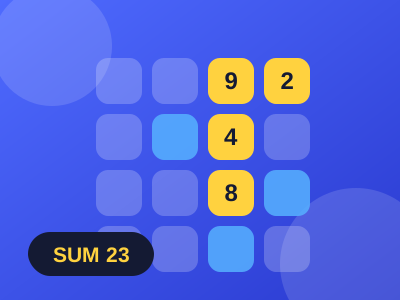
Friend Duel is the standard puzzle with one addition: the board is reproducible. A four-by-four grid of numbers and a target total are generated from a short random seed, and that seed is written into the page address. You solve it by chaining exactly four tiles that each touch the next along an edge, adding up to the target. Anyone who opens your link derives the same sixteen numbers and the same target from the seed, so comparing attempts and times is a fair comparison rather than an approximate one.
How to play, step by step
Opening the page creates a seeded board and puts the seed in the address bar. Solve it, or give it your best attempt. Press Share challenge: on a phone that opens the normal share sheet, and on a desktop the link is copied to your clipboard. Send it however you like. Your friend opens it in any browser, with no account, no app and no sign-up on either side, and plays the same board. Press New challenge for a fresh seed whenever you want a different puzzle.
How seeded boards work
The seed is a short random string, and board generation is a pure function of it. The same seed always produces the same sixteen numbers and the same target, on any device, in any browser, at any time. That is what makes the comparison meaningful without a server storing anything: there is no match record, no lobby and no synchronisation, because both players are deriving the identical board independently from the same input. It also means the link never expires. A challenge you send today rebuilds correctly in a year.
What the link actually contains
Only the seed. There is no player name, no score, no identifier and no tracking parameter attached, and nothing about your visit is uploaded when you share. That is worth knowing because it makes the link safe to post publicly, not just to send privately: pasting it into a group chat, a forum or a public thread reveals nothing about you. Someone opening it is simply handed the same puzzle. Because the seed is the whole payload, the same link can be reused as many times as you like and sent to as many people as you like.
Why the board is always solvable
The target is not chosen and then checked against the numbers. The generator walks a connected path of four tiles across the board first, sums those four numbers, and publishes the result as the target. The answer therefore exists before either player sees the board, so you can never send someone an impossible challenge. The game also checks the total rather than the path, so on many boards several different chains reach the target. Your friend beating you with a completely different-looking chain is normal, not a bug.
How to run a fair duel
Send the link before telling anyone your result. Knowing that a board took three attempts changes how it feels to play, and knowing the target was reachable with the two largest digits gives most of the puzzle away. If you want to compare times rather than attempts, agree to start when you open the link, because the timer begins on your first tile rather than on page load and studying the board beforehand is otherwise untracked. For a group, one link sent to everyone at once is the cleanest format, since every player gets the identical board and nobody needs an account to take part.
Strategy for a board you cannot preview
The reasoning is the same as the daily grid, and the mode is fixed at the medium range, so totals average around twenty. Read the target first and decide whether you need the large or small digits. Find the two biggest adjacent numbers and work out what the remaining pair must contribute. After a miss, use the exact difference rather than guessing again, because being told you are three over usually means swapping one tile. And keep all four legal shapes in mind: a straight line, an L bend, an S or Z kink, and a two-by-two square block. The square block is legal and it is the shape players consistently fail to look for.
Common mistakes
Telling someone your score before sending the link is the one that spoils the duel. Moving diagonally is the rule most often broken by a newcomer opening your challenge for the first time. Hunting only for straight lines misses the bends and square blocks. Pressing New challenge before sharing replaces the board you just solved, so the link you send will not be the one you played. And assuming the revealed solution is the only answer leads people to think a friend cheated when they simply found a different chain.
What is not saved
Challenge results are not recorded. There is no head-to-head history, no win record between you and a friend, and nothing is uploaded, because no server is involved in a duel at all. The comparison lives in whatever chat you are having. The daily grid is the mode that keeps a streak, a win count and a best time, and it stores them in your own browser.
Accessibility
The board is a real grid in markup, with each row exposed as a row and each tile as a cell, so screen readers describe a table of cells rather than a run of buttons. Tiles announce their value, their position in your chain when selected, and whether they are a legal next move. Illegal tiles are genuinely disabled rather than dimmed, so keyboard and switch users skip them. The running total and feedback line are live regions. Sharing falls back sensibly: where the operating system share sheet is unavailable the link is copied to the clipboard instead, so the feature does not depend on a modern share API being present.
Common questions
- Does my friend need an account?
- No. They open the link in any browser. No sign-up on either side.
- Will they get exactly the same numbers?
- Yes. The board is derived from the seed in the link, so it is identical everywhere.
- Can I reuse a challenge link?
- Yes. The same link always rebuilds the same board, and it does not expire.
- Is it safe to post the link publicly?
- Yes. It contains only the seed — no name, no score, no identifier.
- Can I send an unsolvable board?
- No. The target is calculated from a real chain on that board before it is shown.
- My friend used a different chain. Is that allowed?
- Yes. Any connected chain of four tiles reaching the target is accepted.
- What if sharing does not open a share sheet?
- The link is copied to your clipboard instead, so you can paste it anywhere.