

The rules in full
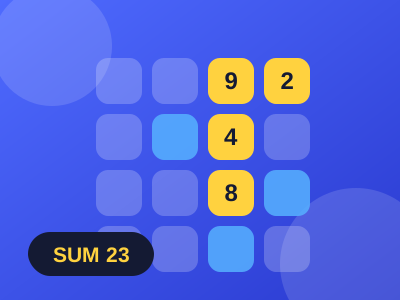
Every board is a four-by-four grid of numbers with one target total above it. You win by selecting exactly four tiles that form a connected chain and add up to the target. Connected means each tile shares a full edge with the previous one, so diagonal moves are never legal. A corner tile has two legal neighbours, an edge tile three and a middle tile four. No tile can be reused. The rules are identical to the daily grid; the only differences here are that you choose the difficulty and that you can play as many boards as you like.
What each difficulty actually changes
Difficulty changes two things at once: the range the numbers are drawn from and how many attempts you get. Easy draws from 1 to 6 and allows four attempts. Medium draws from 1 to 9 and allows three, which is exactly the daily grid. Hard draws from 2 to 12 and allows only two. The narrower Easy range makes totals cluster tightly, which usually means several chains reach the target and finding one is quick. Hard both widens the range and lifts the minimum to 2, so totals spread much further apart and coincidences are rarer, which is what makes two attempts feel tight rather than merely fewer.
Every board is solvable
The target is never chosen and then matched against the numbers. The generator walks a connected path of four tiles across the board first, adds those four numbers, and publishes the sum as the target. The answer therefore exists before you ever see the board, and no setting can produce an impossible grid. The game then checks your total against the target rather than your path against the one it walked, so on many boards several different chains are accepted and yours can legitimately differ from the solution revealed after a loss.
Why practice exists separately
The daily grid is one board per day with a streak attached, which makes it a poor place to experiment. Practice is the same puzzle with the consequences removed. Nothing here touches your streak, your recorded best time or your win count, so you can deliberately try a chain you suspect is wrong just to see what the difference message tells you. That is the fastest way to learn the arithmetic, and it costs nothing. It is also the right mode for learning the adjacency rule, which is the thing most new players get wrong.
Strategy that transfers to the daily
Read the target before touching the board and decide whether you need large or small digits. Find the two biggest adjacent numbers and ask what the remaining pair must contribute; on Medium, where the average total sits near 20, a target of 30 or more almost always requires the largest cluster on the board. After a miss, the game tells you exactly how far above or below you landed, which usually means swapping a single tile rather than rebuilding. And practise recognising all four legal shapes: a straight line, an L bend, an S or Z kink, and a two-by-two square block. The square block is legal and it is the one players consistently overlook.
A worked example
On a Medium board the target is 24, and the top-left corner shows 9 and 7 side by side with 3 and 5 beneath them. Chaining 9 to 7, down to 5 and left to 3 gives exactly 24, and that shape is a square block rather than a line. Suppose instead you tried 9, 7, 6, 4 along the top row and reached 26. The game reports two above, so you do not need a new chain, you need one tile two smaller. Swapping the 6 for a 4 or the 4 for a 2 closes it. On Hard the same reasoning applies but you have one fewer attempt to spend finding it out.
Common mistakes
Moving diagonally is the rule most often broken. Hunting only for straight lines and missing bends and square blocks is next. Clearing the entire chain after a wrong answer instead of undoing a single tile wastes the position you had built. Ignoring the difference message and submitting an unrelated guess wastes an attempt, which matters most on Hard where you only have two. And starting on Hard before the adjacency rule is automatic tends to teach frustration rather than the game; Easy exists precisely so that the rules become second nature first.
What is not saved
Practice results are not recorded. There is no best time, no win count and no streak for this mode, and nothing is uploaded. The daily grid is the mode that keeps a record, and it stores it in your own browser rather than on a server. Switching difficulty or starting a new board here has no lasting effect of any kind, which is the point.
Accessibility
The board is marked up as a real grid, with each row exposed as a row and each tile as a cell, so screen readers describe it as a table rather than a run of buttons. Every tile announces its value, its position in your chain when selected, and whether it is a legal next move, so the highlighting is never the only signal. Tiles that are not legal are genuinely disabled rather than dimmed, which means keyboard and switch users skip them instead of testing each one. The running total and the feedback line are live regions, so changes are announced without moving focus. The difficulty control is a set of toggle buttons that report which one is active, and every control meets the minimum touch target size.
Common questions
- How many boards can I play?
- Unlimited. There is no daily limit and no cooldown.
- Does practice affect my streak?
- No. Streaks, wins and best times belong to the daily grid only.
- What is the difference between the difficulties?
- The number range and the attempt count: Easy is 1 to 6 with four attempts, Medium 1 to 9 with three, Hard 2 to 12 with two.
- Which difficulty matches the daily grid?
- Medium. It uses the same range and the same three attempts.
- Can a board be unsolvable?
- No. The target is calculated from a real chain on that board before it is shown.
- Is there only one right answer?
- Often not. Any connected chain of four tiles reaching the target is accepted.
- Can I change difficulty mid-game?
- Yes. Switching deals a fresh board at the new setting.