


The rules in full
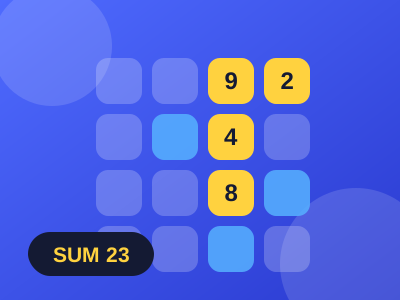
Timed Run gives you sixty seconds to solve as many boards as possible. Each board is the standard puzzle: a four-by-four grid of numbers and a target total, cleared by chaining exactly four tiles that each touch the next along an edge. Difficulty is fixed at the medium range, the same as the daily grid, so the boards themselves never get harder as the run progresses. What makes it difficult is that the clock does not stop for anything, including the moment between finishing one board and reading the next.
How to play, step by step
Press Start to begin the sixty second clock. Read the target, then chain four connected tiles and submit. A correct total scores immediately and moves you to a fresh board. An incorrect total tells you how far above or below you landed and lets you try again on the same board, costing only the seconds it took. When the clock reaches zero the run ends and your score is shown, along with the option to share it or start again. There is nothing to lose beyond time, so there is never a reason to stop early.
How the speed bonus works
A solved board is worth one hundred points plus roughly one extra point for every second of the round you did not consume, counted up to sixty. Solving a board in eight seconds therefore pays substantially more than solving the same board in thirty. This single rule inverts the instinct the daily grid teaches you. There, with three attempts and no clock, careful verification is free and correct. Here, verification costs bonus points on every board, so committing to a chain you are reasonably confident about beats confirming a chain you are certain about.
A miss costs time, never the run
Getting a board wrong does not end anything. You stay on the same board, the difference message tells you exactly how far off you were, and you can adjust. The only price is the seconds spent. That makes the arithmetic simple: if you can fix a chain in three seconds using the difference, do it, because abandoning a board and reading a fresh one takes longer than that. Where the calculation flips is when you have no idea why you were wrong. Staring at a board that is not yielding costs more than the failed attempt did.
How it differs from Endless Climb
These two modes pull in opposite directions and are worth playing as a pair. Timed Run applies pressure with a clock but can never end your run early, so it trains recognition speed and rewards decisiveness. Endless Climb removes the clock entirely, gives you three lives, and raises the difficulty as you advance, so it trains consistency and punishes carelessness. Timed Run makes you faster at spotting a chain. Endless Climb makes you more reliable at finishing one. The daily grid needs both, which is why alternating between them improves your daily result faster than grinding either alone.
Strategy the scoring rewards
Scan for the two largest adjacent digits before anything else, because most medium-range targets need them and spotting them immediately narrows the search. Do not verify a chain twice; the bonus is paid for the seconds you save, and a second check almost never changes the answer. Your first two solves set the tone for the run, since early points arrive with the largest bonus available and a slow start cannot be made up later. When a board resists for more than a handful of seconds, accept the miss and let the difference guide one adjustment rather than restarting your thinking. And remember all four legal shapes, especially the two-by-two square block, because hunting only for straight lines wastes exactly the seconds this mode charges you for.
A worked example
The target is 22 and you can see 9 and 8 adjacent near the middle. Those two give 17, so you need 5 from two more connected tiles, and a 3 and a 2 touching the 8 complete it. Recognising that pattern takes perhaps four seconds and pays close to a hundred and fifty points. Now suppose you submitted 9, 8, 3, 4 for 24 instead. The game says two above. You do not need a new plan, you need one tile two smaller, so swapping the 4 for a 2 finishes the board and the whole correction costs about two seconds. Rebuilding from scratch would have cost eight.
Common mistakes
Playing Timed Run like the daily grid is the main one: careful, verified, and far too slow. Checking a chain twice is the specific habit that costs the most. Abandoning a board immediately after a miss throws away the difference message, which is the cheapest information in the game. Hunting only for straight lines misses the bends and square blocks that many targets require. And restarting the run after a weak first ten seconds is rarely worth it, because the clock is short enough that a mid-run recovery is entirely normal.
What is not saved
Timed Run scores are not recorded between visits. There is no high score table, no personal best and no history for this mode, and nothing is uploaded. You can share a score, which produces a short piece of text on your own device containing the score and a link, and nothing else. The daily grid is the mode that keeps a streak, a win count and a best time, held in your own browser.
Accessibility
The board is a real grid in markup, with each row exposed as a row and each tile as a cell, so screen readers describe a table of cells rather than a row of buttons. Tiles announce their value, their position in your chain when selected, and whether they are a legal next move. Illegal tiles are genuinely disabled rather than dimmed, so keyboard and switch users skip them. The running total, the feedback line and the remaining time are all live regions, which matters more here than anywhere else on the site because the clock is the thing you cannot see if you are not looking at it. Every control meets the minimum touch target size, and decorative motion is suppressed when the system asks for reduced motion.
Common questions
- How long is a run?
- Sixty seconds, and the clock never pauses, including between boards.
- Does the clock stop while I read a new board?
- No. It runs continuously for the full sixty seconds.
- What happens if I get a board wrong?
- You stay on it and can try again. A miss costs you time, not the run.
- How is the score calculated?
- One hundred points per solve, plus about one point for every second of the round you had not used.
- Does difficulty increase as I go?
- No. Timed Run stays at the medium range throughout. Endless Climb is the mode where difficulty rises.
- Is my score saved?
- No. Scores exist for the run only. The daily grid is the mode that keeps records.
- Do I need an account?
- No. There is no sign-in, no email and no download.