
The rules in full
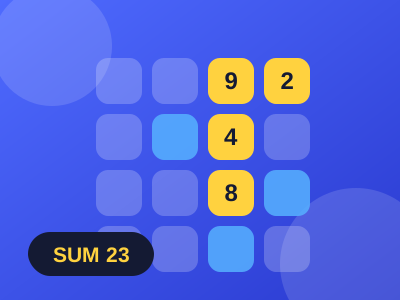
Endless Climb has no timer. You begin at round one with three lives and advance by solving each board. Every board is the standard puzzle: a four-by-four grid of numbers and a target total, cleared by chaining exactly four tiles that each touch the next along an edge. Failing a board costs one life and reveals a valid solution before moving you on. The run ends when the third life is gone, and there is no final round, so how far you get is the only score that matters.
How the difficulty actually scales
The climb is not a smooth curve, it steps at two specific points. Rounds one to three draw numbers from the easy range and are deliberately gentle. Rounds four to eight move to the standard medium range, the same as the daily grid. From round nine onward every board uses the hard range, where numbers run from 2 to 12 and only two attempts are allowed per board instead of three. That last transition is the one that ends most runs, because a mistake that was survivable at round six becomes expensive at round nine. Knowing it arrives at nine rather than gradually is genuinely useful: it tells you exactly when to slow down.
Why there is no timer
Removing the clock changes which skill the mode tests. Timed Run measures how quickly you can recognise a chain, and it rewards committing to a likely answer over confirming a certain one. Endless Climb measures whether you can avoid mistakes across a long sequence, and it rewards exactly the opposite behaviour. Because thinking is free here, a careless error is pure waste rather than a trade-off. There is no bonus for finishing a board quickly and no penalty for taking a minute over it, so the correct pace is the slowest one you have patience for.
Read the revealed solution
When you lose a life the board shows a valid chain before moving on. That is the most useful half second in the mode and most players skip it. The revealed chain usually has a shape you were not considering, and since a four-tile connected path can be a straight line, an L bend, an S or Z kink or a two-by-two square block, the shape you habitually overlook will keep costing you lives until you notice the pattern. Treat each lost life as the price of one piece of information and take the information.
Strategy for depth rather than speed
Play the early rounds deliberately even though they are easy, because a careless mistake at round two costs exactly as much as one at round twelve and buys nothing. From round nine, when the hard range and the two-attempt limit arrive together, change how you play: plan the full chain before selecting anything, since you can no longer afford to discover the answer through attempts. Use the difference message properly when you do miss, because being told you were four over means swapping one tile, not rebuilding. Reaching round ten is a solid benchmark. Beyond that the arithmetic does most of the work and consistency does the rest.
A worked example
At round eleven the range is wide and the target is 31, which is high enough that it almost certainly needs the largest cluster on the board. You spot 12 and 10 adjacent, giving 22, so the remaining pair must contribute 9. A 5 touching the 10 and a 4 touching the 5 completes 31. With only two attempts here, the value of working it out in that order rather than selecting hopefully is the difference between clearing the round and losing a third of your remaining lives on it. Had you submitted 12, 10, 5, 6 for 33, the game would report two above, leaving one attempt to swap the 6 for a 4.
Common mistakes
Rushing the easy rounds because they feel trivial is the most common, and it is where a surprising number of runs quietly lose their first life. Not reading the revealed solution wastes the only feedback the mode gives you. Keeping the same pace after round nine, when the range widens and attempts drop to two, ends more runs than any board does. Hunting only for straight lines misses the shapes the generator actually produces. And ignoring the difference message after a miss throws away a correction that is usually a single tile.
What is not saved
How far you climbed is not recorded between visits. There is no personal best, no leaderboard and no history for this mode, and nothing is uploaded. You can share a score, which builds a short piece of text on your own device containing the score and a link and nothing else. The daily grid is the mode that keeps a streak, a win count and a best time, stored in your own browser rather than on a server.
Accessibility
The board is a real grid in markup, with each row exposed as a row and each tile as a cell, so screen readers describe a table of cells rather than a run of buttons. Every tile announces its value, its position in your chain when selected, and whether it is a legal next move, so highlighting is never the only cue. Illegal tiles are genuinely disabled rather than dimmed, so keyboard and switch users skip them instead of testing each one. The running total, the feedback line and the remaining lives are live regions, so a lost life is announced rather than only shown. Because there is no clock, this is the most comfortable mode to play with a screen reader or with any input method that takes longer than a fingertip.
Common questions
- How many lives do I get?
- Three. Each failed board costs one.
- Is there a time limit?
- None at all. You can think for as long as you like on every round.
- When does it get harder?
- At two fixed points: round four moves to the medium range, and round nine moves to the hard range with only two attempts per board.
- Does it ever end on its own?
- No. There is no final round. The run ends only when your third life is gone.
- What happens when I lose a life?
- A valid solution is revealed before the next board, which is worth reading.
- How does this differ from Timed Run?
- Timed Run pressures you with a clock and never ends early. Endless removes the clock and ends when your lives run out.
- Is my best climb saved?
- No. Nothing is recorded between visits for this mode.